Quilters Lead Pieceful Lives.
Showing posts with label Art. Show all posts

Saturday, March 25, 2017

Memories

My mother has been an artist her entire life.  For many years, she painted, primarily using oils. She painted this picture in the early 1960s:


I have always loved it. The colors, the starkness, the isolation....yet the path goes somewhere and you know the tree will bloom again in the spring. The painting itself is only 11.5" x 9", yet it displays unlimited depth.

As a boy, this picture hung in my bedroom; now, it hangs in my quilt studio.  I have looked at it often, and then last fall it hit me: why don't I make a quilt of it and give it to my mom!

This is way out of my comfort zone, so the idea and the process had to percolate in my mind for several months. I did some research on "raw-edge" quilting. This is where you build up a picture piece by piece, with fabric shapes (for a very literal picture) or scraps (for something more abstract). You can applique the pieces (hence the "raw-edge" tag), either by hand or by machine. You can also use fusible web to "glue" the pieces on to the background (again, with or without applique).

In my search I found a wonderful web site from fabric artist Leni Wiener (http://leniwiener.com/) which included a video on "How to create a fabric collage from a photo". This video explains clearly explains the process of turning an image into a piece of fabric art. Much of it deals with determining the color values of the various parts of the photo; something I did not have to deal with here, as my objective was to replicate the painting as closely as I could. But I emailed Leni and explained what I wanted to do and she eagerly gave my other tips and encouragement (both were much appreciated!).

Some of you may remember my "Sunflower Mosaic" quilt, in which I "copied" a van Gogh painting in fabric. That was also raw-edge, and fused, but the image (and each part within) was much bigger. So I was able to make that with small overlapping squares. I did not feel that that technique would work for this piece. But I still wanted to fuse the tree and fence fabrics to the background.

So here is the process I developed:
  • I took a photo of the painting, and printed it full size (so it was 11 x 8.5; not exactly the size of the original, but close enough).
  • Leni showed me how to turn the photo into a gray-scale image.
  • I printed the gray-scale image on a transparent sheet of plastic (for you oldsters: what the teacher used to use on the overhead projector!). This allowed me to use this both right-side up and reversed (more later).
  • I then created a reverse image of the gray-scale one, and printed several copies. This is what I actually used to cut out the pieces (as templates) for the quilt.

You can see that most of the pieces are very thin. I was afraid that even with having the fabric backed with fusible webbing, some of them would just shred into tatters and be unusable. So to eliminate this potential problem, and to make things much easier, I did two things:

First, I made the tree and fence pieces out of two pieces of fabric fused together. Though they look almost identical (in the finished piece), the tree fabric is actually a shade lighter than the fence fabric. So for each, I took one piece of fabric, ironed a piece of fusible webbing to the right side (usually a huge no-no), and then fused a second piece of the same fabric at a 45 degree angle to the first one. This is so the warp and woof threads would be at an angle and reinforce each other. This layering also had the effect of giving some dimensionality to the finished pieces. I then fused another piece of webbing to the back of the bottom piece (and left the backing paper on at this point).

Second, instead of trying to cut out the entire tree or each side of the fence in one continuous piece, I broke the reversed image up into logical pieces. That way, if any individual piece did fray or if I cut it poorly, the whole element would not be ruined. So the large part of the trunk was one piece; a big branch another, a smaller branch a third, etc. I did the same for the fence rails and posts. This allowed me to actually place the background posts on the outside of the background rails (i.e., posts first), and the foreground posts on the outside of their rails (i.e., rails first). Though not that easy to see in the finished piece, doing this better reflects what the reality would be.

Non-quilters may be asking: "Why use a reversed image?" 
Well....here's what happens next:
  • I cut out the pieces from the reversed paper image.
  • Then I taped them to the paper backing on the back of the fused fabric sandwich. Remember your math: two negatives make a positive!  So I have a reversed image piece on the back of the fabric. So when I next cut out that reversed paper piece again (to include the fabric), and flip the whole thing over, the final piece is now un-reversed!
  • Next I peeled off the backing paper (to expose the fusible web) and hand pressed the piece in its correct place. How did I know where to put it? I laid the transparent plastic sheet (right-side up!) over the background and lined it up; initially with the edges of basting threads I sewed on first, but as the image took shape piece by piece, I lined it up with the previous pieces.
  • Once it was in the proper place, I iron-fused it on.
  • Finally, I did some free-motion stitching with matching brown thread over each shape (the branches of the tree, the rails, and the posts). This added more texture and shading, as well as helping to ensure that the pieces would not come off.
Here are photos of the piece partially done:
 

Note that I added a little extra to the pieces that were on the edges. That was to insure that there would be no orange gaps showing through when I added the borders.

Now it's time to talk about the background fabric.
My original thought was to take varying shades of orange fabric and ragged-cut and place them horizontally. This would represent the horizontally-oriented brush strokes on the original. I figured I would reinforce this imagery with some horizontal stitching lines. So, the first place to always look is your fabric stash. I found some orange pieces, but nothing really excited me. At the same time I was exchanging emails with Leni; she thought the background had a silk-like appearance. BINGO! I had made this quilt with silk fabrics that I bought on our India trip. Was there any left? Yes!  Enough? Yes! And it is perfect. It has a ribbed texture and subtle shading that catches the light. Using this fabric, I didn't need to do any quilting in the background at all.

I remembered that working with this fabric was nasty; the edges of the silk were really prone to fraying. So, to avoid this in this piece, I fused a piece of lightweight interfacing to the back. This also added some firmness / stability to the silk.

So I fused all of the tree and fence pieces on. Next up was the border. Once again, I went to my stash to see if I could find fabrics to replicate both the brown-wood and the thin inner-gold highlight of the frame. Success again! I added the borders using mitered edges, again, just like in the original.

Finally, I mounted the finished piece by wrapping it around an 11 x 14 stretcher. That is the actual full size of the original.

And here it is:

I think it is pretty darn close to my mom's painting; no?

So....is this a quilt?  Well, technically, no. It is not made up of a fabric-batting-fabric sandwich. I guess you would call it fabric art.  Either way, thanks Mom for all the memories! xxx


Wednesday, June 10, 2015

Motion

I like playing with black and white patterns, especially when they can be considered Op Art.  Two of my better examples of this are Labyrinth and Stand Back!!  This quilt does not quite have the same "pop" factor, but it still makes the eye travel back and forth across the canvas.


To reinforce the flow of this original piece, I scoured the internet for just the right fabrics. If you look very closely, you will see that the pattern on the black fabric is actually made up of very tiny black and white lines (click here to see a close-up swatch) that are angled at 45°.  The white fabric has very subtle white-on-white lines (click to see), which I arranged so that the stripes are all vertical.  Thus, the fabrics themselves reinforce the movement from bottom left to top right (or is it top right to bottom left?).

All of the vertical sections are solid (i.e., one-piece) strips. 

I pressed all the seams open because I did not want to create ditches, so I had to be extra precise when matching up the seams. This resulted in some seams being resewed two or three times to get them to line up perfectly. Even so, the seam gnomes came during the night and offset some of them just a wee bit. So it is better to view the quilt from several feet away.

For sale: 42" x 37"  Wall hanging (mounted on stretcher bars)  $150 


Monday, September 29, 2014

Lines

...or what I did on my summer vacation.

I finished my previous quilt right before we left for Greece and Turkey. And, for one of the few times, I had nothing else in my queue! So when we got back I looked around for a good project to help pass the summer away. Stumbled across the work of Emiko Loeb, a Japanese textile artist who does some amazing things. I found one that I liked and adapted it into the piece you see here. Thus the name: "Lines".


It is a simple piece which features the interplay of the 4 shades of blue and the 5 shades of gray, spiced up with the "woven" black strips as a counterpoint.  Trying to find five shades of gray that worked together was a real challenge (good thing I wasn't looking for 50!). For this piece, I felt I needed fabrics with a very minimal pattern so as not to distract from the design itself.  

I designed the construction using the 5 grays as the vertical sections. Within them are squares and rectangles and strips that build up into bigger sections. Of course, no set-in seams. There are only 118 pieces, so it did not take very long to do the cutting and finish the piecing. You may be able to see some of the seams if you look really closely.

One oddity is the dark gray band in the lower left side that looks like it is a shadow from the black strip. It really is the same color gray as the rest of the section, but even in person it looks darker. No idea why. Maybe one of those eye vs. mind things.

Coincidentally, as I was putting it together, I saw a write-up on matchstick quilting. This is a technique where the quilting is done in 1/4" lines over the entire quilt. I jumped up! Lines! This seemed like the perfect approach to take for this piece. Oh...If I had only known.

I have done pieces with shadow quilting before (which is similar), but this was a different beast altogether.

For the quilting, I decided to match the thread colors in each of the 5 gray sections. And there would be no quilting on the blue or black strips, so that they would "pop' a little (actually, I did ditch quilt around all of them using clear monofilament thread).

And off I went. And went. And went.  OK....1/4" lines....on a piece that is basically 34" x 42". Start...stitch...stop...jump...repeat.  When it was all done, it took nearly two months of work, and there are a total of 773 individual parallel lines of quilting!  Easily, the most extensive quilting I have ever done.

Like many of my other "art" quilts, I put this one on stretcher bars, like a painted canvas. So no need to bind. 

And since I did this just for fun, I am offering it for sale!  The price is $150 (plus shipping if you are not local) or free to relatives.  If you're interested, send me an email. 

Saturday, January 18, 2014

Sunflower Mosaic

As you have probably noticed, I am always looking for something new to do in the quilting genre and am always up for a challenge.  One of the things I've had in my to-do queue has been a mosaic quilt. I got the idea this summer while at the British Museum in London. We saw some ancient mosaics and I thought "that would be neat to do in a quilt".  Obviously, you would want to keep the size of such a piece to a minimum (no bedspreads here!).

A little over a month ago, my mother-in-law Pauline requested another quilt for her apartment. She has a small wall in the bathroom over the towel bar that is vacant (heavens!), and asked if I could come up with something to put there.  Bingo! Mosaic time!  She wanted something bright, and it just popped into my head: van Gogh's Sunflowers!  Here is Vincent's original:


Yup!  That'll do.


So I did some Googling on "mosaic quilts" and eventually found an excellent how-to book: "Mosaic Picture Quilts", by Pat Durbin. The process is similar to making a watercolor quilt (like this one) or a
postage stamp quilt (like this one) in that tiny squares (in this case 1 1/8") are used to make the picture, but that's where the similarity ends. Watercolor quilts are pieced (sewn) like most other quilt tops (and the focus is on color "value"). Postage stamp tops are sewn or fused and then sewn. Mosaics are simply fused.

For mosaics, first you put a transparent grid (also purchased from Pat Durbin) over the original picture. Like so:

Each of the squares should then be treated as if it were a pixel in a digital photograph.
You then draw squares (mine were 1") on a large piece of paper. In effect then, you scale up the original picture to the actual finished size of the quilt. You can then draw the picture, square by square, onto the large sheet, or just use the original + transparency as a guide as you go along. My objective was not to try to duplicate the picture exactly, but to make a reasonable facsimile out of fabric.

Next, a thin, non-fusible interfacing is placed over the large paper. This is the base that the squares will be fused onto. You want it to be thin enough that you can still see the grid squares (and/or drawn-in pattern) through it.

Now the fun part (well, the first fun part): I went through my stash to find appropriately colored scraps of fabric. I ended up with a whole bunch, but as I started the mosaic process, I realized that using batiks (or at least somewhat mottled fabrics) was a better approach than trying to make tiny pieces of different fabs blend together nicely.

Then, starting at one corner and working diagonally, I cut a square (lined with Steam-a-Seam Lite), and fused it into place.  In some areas, as I went along, I sketched parts of the picture directly onto the interfacing. For those squares on the original that had multiple colors (say part of a petal and part of the blue background), I would cut and trim two (or more) fabrics) to approximate the "pattern" (pixel) in that same square of the orig-transparency.  Besides being necessary to creating the facsimile, this adds some dimensionality to the piece.


The squares are 1 1/8", so that when they are fused onto the 1" grid there is a slight overlap (as you can see above). So this is a "mosaic" technique in the sense of building a picture with tiny pieces of material, but, of course, in tile mosaics, there is no overlap.


And here is the final result:


Since the piece has all of those fused squares (some with 4 layers of fabric!), plus the interfacing, it is pretty stiff. Of course, there is also the batting and backing fab. And since it is a small, wall-hanging piece, there was really no need for a lot of quilting (you can see the quilting better from this photo of
the back):


The vase is not quilted; this may make it physically stand out from the quilted areas, though not as much as in a normal (i.e., just pieced) quilt.

Because of the fusing, I didn't want to hold the layers together with safety pins as I normally do (holes in fused pieces do not "heal" when the pins are removed!). So I did something which is normally an anathema in quilting: I basted close to the outer edge on the bottom and 1/3 of the way up each side. This allowed me to keep the sandwich together without pins while I got the quilting going. After I quilted the "table" and a few inches of the background, I removed the basting and just held the rest together with a few thin straight pins parallel to the top (and right near the edge, where the holes would later be covered by the binding).

And speaking of the binding, I did something which I don't think I've done before (another challenge!): since this is supposed to look like a painting, I didn't want the narrow binding to appear as a "skinny frame". So, instead of making one long strip that would go all the way around (as is normally done), I made two strips. Each strip consisted of one part background blue fab and one part table bottom brown squiggles fab. I then sewed them on as usual, but had to join the raw ends at both the top and bottom.  So the binding is integrated into the picture and is actually barely distinguishable.

And there it is. My first mosaic quilt!

When I gave it to Pauline, she insisted that it be hung in the living room, as it is "too nice to hide in the bathroom". So that's where it now resides.

For additional tips and information, see this post in my Quilt Tips blog.

Tuesday, July 30, 2013

Begin Again

Earlier this year, after 20+ years in a big old house in Oak Park, my brother- and sister-in-law, Mike and Brooke, downsized and moved into a condo in Evanston.  That is the origin of the name that she chose for this work.

Brooke has very eclectic tastes, and the furniture and accessories in their new place reflect this. Among these accessories are some stained glass panels.  But she saved the wall over their fireplace for a unique piece and commissioned me to make it.

Brooke is an artist, and she came up with this design as a starting point:

It picks up on other colors in the room, and also echoes some of the elements of the stained glass.

I took that rough design and put it into Excel and began playing with the colors, the arrangement, the sizes, and the shapes.  We went back and forth over a number of iterations (discovering in the process that an iPad does NOT always accurately display the Excel graphics!), and eventually agreed on a final design.

Here is the result:

Rather than using a traditional piecing approach (except for the light and dark gray backgrounds), I decided to cut the pieces to size and then fuse them on. This is the same approach I took with   Reflections [Visualize Whirled Peas]. Then I stiple quilted the background and did horizontal, vertical, and circular (as appropriate) free-motion quilting in the objects.

Finally, the finished quilt (46 x 28) was mounted on wooden stretcher bars.

And here it is in its place of honor:

Saturday, February 5, 2011

Through A Glass Darkly


This is a very unusual quilt for a number of reasons:

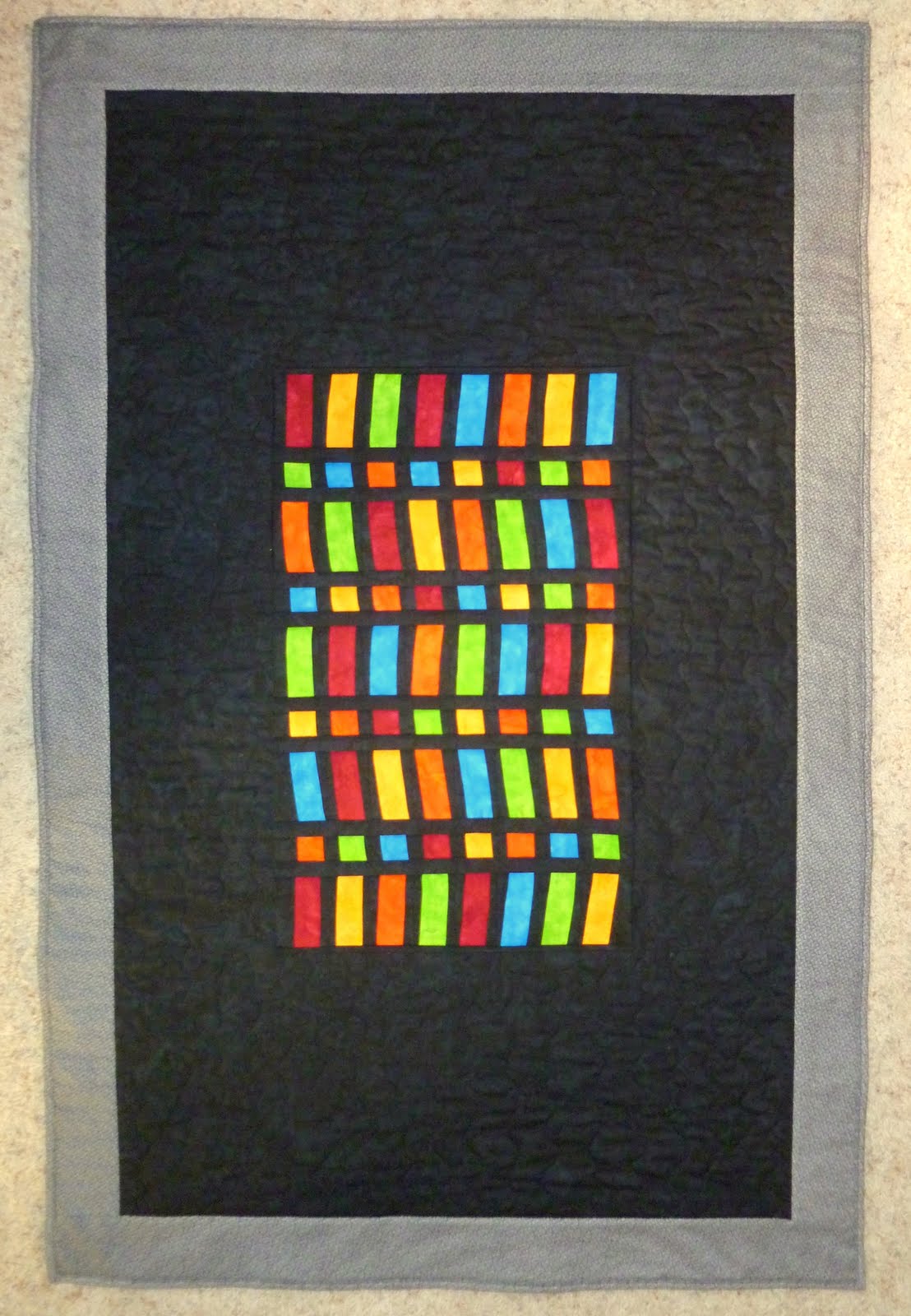
First, the idea. It came from a picture of a rug (below) that I noticed in a magazine while we were in Healdsburg, California for my mom’s and sister’s birthday party in 2005. I liked the playful, condensed block of colors against the larger, dark background.


Next, the design. Obviously, the quilt could not be anywhere near as large as an actual area rug. I figured that about 40” x 60” would work. So there had to be enough repeats in the center medallion to produce the intended affect, but overall it had to be small enough to allow for a large background and border and still fit into the desired size. Additionally, the colored rectangular mini-blocks had to be designed so that each had a slight tilt. Then, there are the smaller square blocks in the alternating rows, and a thin sashing strip that separates them (the vertical sashing is incorporated into the mini-blocks). The fabric for the main background is actually black with some dark blue highlights (hard to see, but they really are there). This was done to add some interest and avoid a dull, flat looking expanse without directly moving the focus from the center. The goal was to make the medallion “pop” both visually - through the colors-on-black, and physically - because it is actually floating above the background’s surface!

Then, the execution. This is the most unusual aspect of this piece. It is actually a quilt on a quilt! First, the medallion: The mini-blocks were pieced and cut as regular rectangles. Then I used a template at an angle to create the tilt. And, in a very rare approach (for me at least), I pressed the seams open. This was done to avoid extra bulk in the mini-blocks and also to minimize the visibility of the seam lines. The blocks were then assembled into rows and joined to the sashing and the square-block rows. The medallion was then made into a sandwich with batting and a piece of muslin. The top, bottom, and side sashings were intentionally left large so that they could be folded to the back and whipstitched in place. Then the entire piece was set aside.

I did not want any seams to mar the expanse of the background, so it was cut from one single piece of fabric. The borders, batting, and back were added as if this were a regular quilt top. I then stiple quilted in wavy black lines to mimic and reinforce the back-and-forth motion of the mini-blocks. The binding and sleeve finished off this part of the project.

The medallion set was then centered and ditch quilted on top of the larger quilt.

Finally, the name. Once again, I am at a loss for what to call this piece. So I am calling on everyone to be creative and come up with an appropriate (and unusual?) name. Submit as many entries as you want (along with an explanation if necessary). The winner will get a morsbag in the color of their choice.

And what’s not unusual about this quilt? It will hang in Pauline’s apartment of course!

Sunday, March 14, 2010

Point, Counterpoint


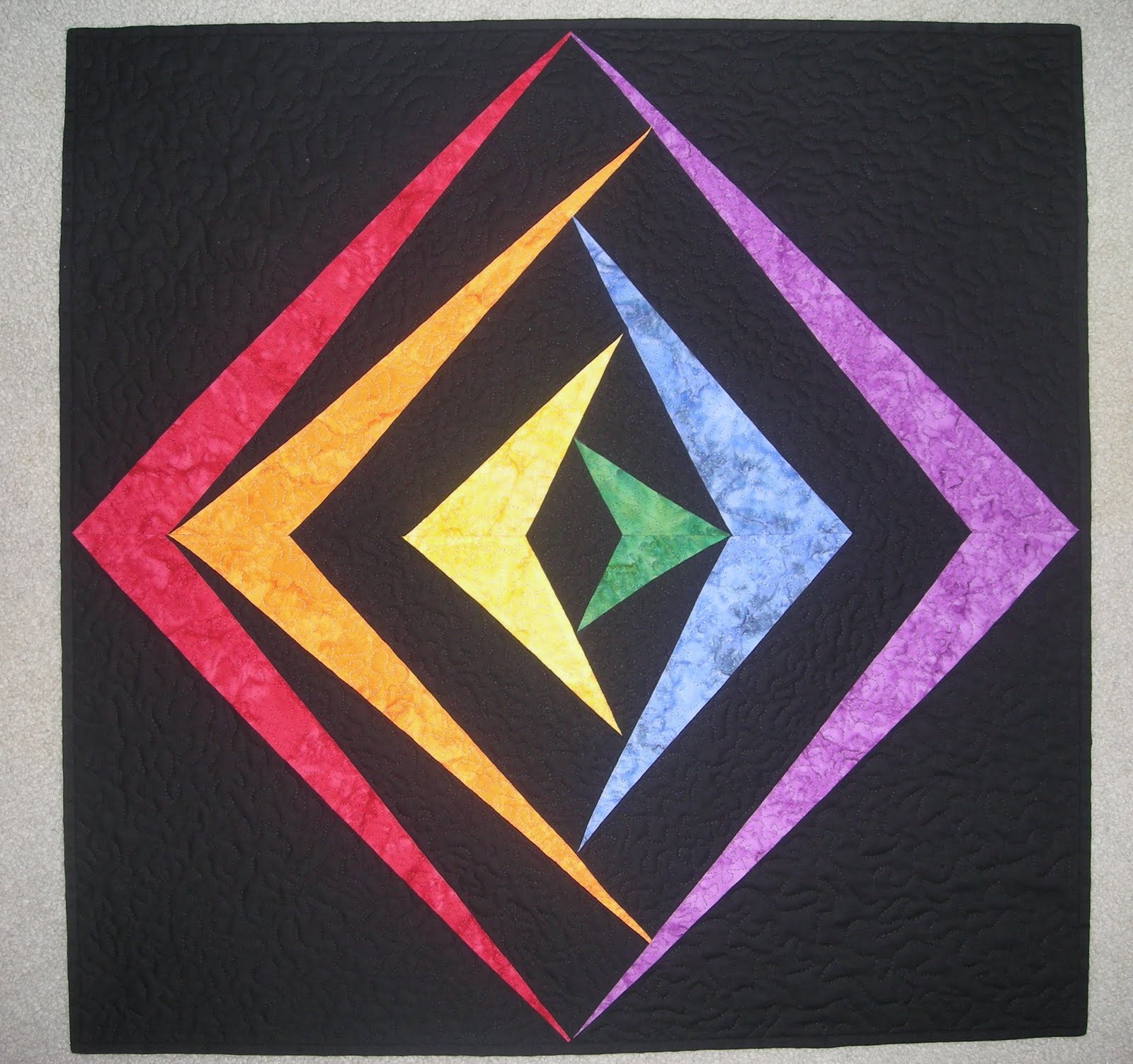
This is a work I designed based on the painting, below, by Geraldo de Barros. The original (an enamel, 23.5" x 23.5", 1952) is in black, white, and light blue. The hues and shapes do indeed appear to show movement, or, at least, tension.


I did my version (29" x 29") in the primary (rainbow) colors. It does not have the same sense of movement as the original, but I believe that the bright colors and interplay of the shapes against the stark black background do have an interesting vibrancy.


For the quilting, I chose to do stipling. The thread colors match the black or colored fabrics. So if one looks at the back of the quilt (which is a solid black fabric) the outline of the points and counterpoints on the front are clearly visible.

Wednesday, September 10, 2008

Paschke Homage - Hot Fax


The late Ed Paschke is my favorite artist. For 4 decades he created stunning pieces with brilliant colors and shapes. Click here to see his collected works.

This piece is dedicated to his memory. It is an attempt to capture those colors and the often jarring juxtaposition of objects that characterized his art.


The original "Hot Fax" is pictured below.